Showing posts with label writing. Show all posts

Tuesday, July 16, 2013

Another Conference under My Belt - LexiCon 2013


     LexiCon Writers Conference met in Denton, Texas for its second year. Mitch Haynes honored me by asking me to be a speaker. I didn't know what to expect of a small, relatively new conference, but the enthusiasm of the founder, Mitch Haynes, and others who had attended the first year intrigued me. 

Mitch Haynes as Alex Cord  listens
  Jacque Graham, my "keeper," and I arrived at the Hilton Garden Inn to find comfort and excellent service. After setting up the books in the book nook and registering earlier, Friday night, July 12, the conference began with a Meet 'n Greet dinner. No one could hide and be shy with so many friendly people around. We visited with friends of a long time, Denise Bartlett and Charlotte Holley of Gypsy Shadows Publishing. We met new people and made new friends. We saw several OWFI members and many from Oklahoma, familiar names and faces. We met people such as Alex Cord, who was Jan Vincent Michael's sidekick on the TV series Air Wolf.

     I attended what sessions I could, and the variety and content amazed me. Yes, LexiCon might be small and young, but the conference itself offered much. I presented my session Saturday evening in competition with the opening of the bar. Hmmm ... some people preferred the bar, of course. *laugh*

 
    A pitch panel listened as authors "pitched" their books. We then gave suggestions for improving their pitch and even the beginning of their books. The concept worked except it lacked the personal touch that brought us, the publishers, submissions. Only one publisher on the panel was a straight traditional publisher for print books, then offering eBooks, me.

     Some well-known names attended the conference, many participated in one way or another other than as listeners. Ken Farmer (the Wolf Brand Chili cowboy and movie villain) spoke, as did Bill Wetterman and Thomas Miller, fellow OWFI members.

    However, the highlight of the conference came Saturday evening when keynote speaker Dave Lieber entertained us, and I do mean entertained. He made us laugh and think and want to write. Wow! Dave is now the consumer columnist for The Dallas Morning News, but he, a misplaced New Yorker, spent 20 years on the Fort Worth Star-Telegram. 


     Sunday morning we had the pitch panel as well as other sessions. One young lady who "pitched," eighteen years old, blew off all our socks. She is one I wish would submit to 4RV Publishing, but another "publisher" had an inside track.

    
     If you can manage to clear a weekend in July 2014, find your way to the LexiCon 2014 Writing Conference. You won't be disappointed.


Monday, May 6, 2013

2013 OWFI Writing Conference Update

     I don't remember how many years I've attended the OWFI writing conference, but I believe it's been at least eleven or twelve years. During that time, I've been the BasketWars chair for eight years or more. BasketWars is the silent auction that raises money for scholarships for the next year's conference. This year's total raised broke all records, and we'll be able to give at least nine scholarships for the 2014 conference, Create, Compose, Commit.

     This year, the conference had exhibitor tables, and 4RV Publishing had an excellent location for its. We had a limited number of titles available due to the lack of space, but many people were impressed with our books. Too bad more didn't buy copies. However, we did sell some, and people took cards so they could go to our bookstore site. Rita Durrett, whose book Borrowed Time will come out next year, and vehoae, whose nonfiction book Conscience: Breaching Social Amnesia is out, helped man the table. Others associated with the company did, too. Tony LoPresti and his daughter Rimanda helped vehoae, who worked the table both days. Rimanda helped all day Saturday. I didn't get photos of everyone at the 4RV booth, but Wayne Harris-Wyrick worked shifts both days. Vickey Kennedy Malone, one of the 4RV editors, worked at least two shifts, and Suzy Koch helped all afternoon Friday. Other authors who took shifts included Janet Brown and Kathleen Gibbs. Jacque Graham, as usual, aided. 

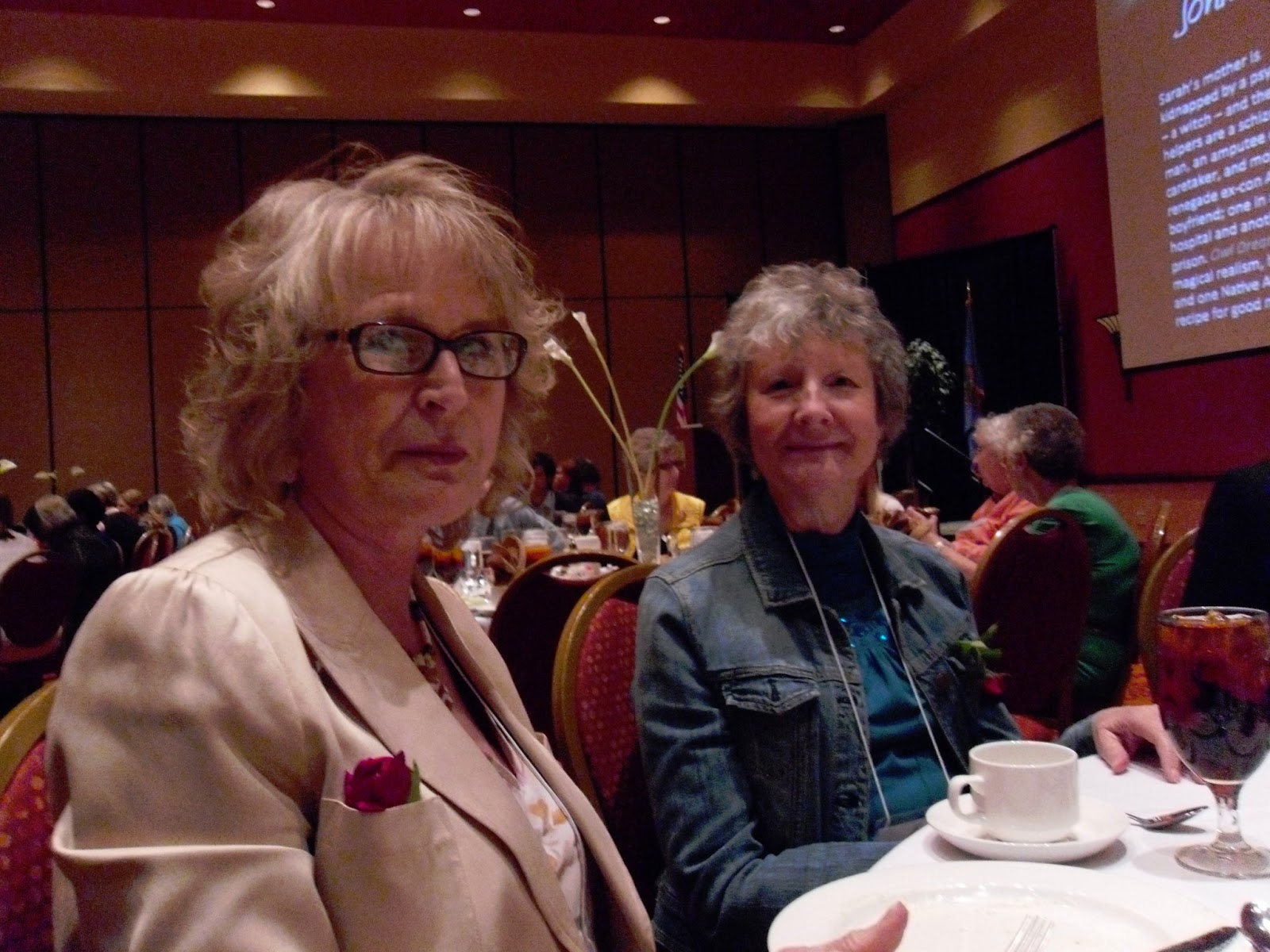
     Janet Brown and I posed for a picture after the Friday night banquet. Kathleen Gibbs joined Jacque Graham, her son James, Dianne Sagan, and Kimberly Black at the Pen and Keyboard Writers reserved table Friday night. Dianne writes for Love Inspired regularly, and I always watch for her books. Kim's first novel came out this past year. For me, meeting and seeing again other authors, some who are quite famous, is exciting. I may only see some of these people once a year, some times not ever every year, but they are friends.
Kathy Gibbs and Dianne Sagan
Dianne Sagan and Kim Black
James Graham and Jacque Graham

      I was able to attend part of Jordan Dane's session, and if anyone can help writers at each stage of their career, Jordan can and does. I enjoyed seeing her again, but I didn't get to visit much. We need her back in Oklahoma, not way down in southern Texas. 

     One returning speaker, Jack Dalton, leaves everyone wanting more. I told him that as far as I was concerned he had an open invitation to join us every year. Other speakers attracted writers interested in their areas of expertise. We had graphic novel speakers, fantasy speakers, experts in the eBook arena and in social media. 


          I enjoyed seeing friends and making new ones.


Sunday, June 24, 2012

Why Are Soap Operas Dying?

            Once upon a time, way back when I was young, some of the better writing (and better acting) was found on daytime television, on soap operas. Yes, that's the truth. In fact, I told my first drama class that, and the students laughed. They couldn't understand how any writing or acting could be better than "Mork and Mindy." I told them to tell me at the end of the year if their opinion remained the same or not.

          Let me digress a bit. I had taught English and speech/drama/debate but hadn't had a separate drama class until that year. I prepared for a class of all girls, of boys and girls, of mainly girls with a few boys; but the class was all boys. Yes, a different experience, but an interesting one, probably the best drama class I ever taught.

         But back to soap operas and writing. Of course the class of boys thought I was nuttier than any other teacher. I gave them an assignment at the end of the first semester: Watch at least five episodes of a soap opera and write a report concerning the believability of the writing and acting. With days off for teacher meetings and holidays, I knew they could easily watch five or more without missing any classes. At that time, as I wrote above, some of the better writing and acting could be found in daytime dramas.

         When the students handed in their reports, we spent the class discussing what they discovered. They first expressed shock, and then they told me I had ruined their enjoyment of their favorite show.

         Soon after that class finished, soap operas began their downward slide. The believability disappeared as the characters followed a script where they played musical beds, even the couples who had been married with a stable marriage for years and years. Characters could do despicable things for ages, but when they decided to "go straight," they suffered no consequences of their previous actions, in fact other characters accepted their change without even a reference to what had happened in the past. In other words, the writing became poor.

         After the local news at noon, a thirty-minute soap opera comes on the channel I watch. I use TV as background as I work on my computer, and often I don't change the channel until another show comes on at one o'clock that I watch. As I said, the television is background, but that show started to catch my attention -- not because it was good or interesting. I had a hard time believing that such terrible writing could be tolerated even for a let's-sleep-around-and-manipulate-people drama. No wonder networks are cancelling soap operas. The wonder is how any still exist and haven't been cancelled.

         The plot, which has unfolded painfully slowly (yes, two -ly words, but needed) the past two months, has two lovely woman in love with one man who can't make a real decision for himself, who allows himself to be manipulated, and who "loves" and wants both women. What? No woman in her right mind would want to hold on to such a wimp, such a spineless not-a-man. The past week used thirty minutes a day for five days to cover maybe three hours of time in the story, if that long. The man finally is supposed to marry the blond. Her biological father shows up at the hotel after the groom left for the church. She loses track of time, rushes out to take the limo to the church, but the limo left. She talks the gardener into taking her to town and the church while she holds on to the frame in the open back of a small truck. At the edge of town the road is blocked, so she hauls herself out and runs up the hill and through town to the church, fluffy bride's gown dragging and billowing.

         With me so far? Find anything believable yet?

         The groom, after waiting for over an hour, drives back to the hotel to find her. There, instead of her, he finds a note stating, "I love you, but I can't go through with this." The dark haired beauty finds him ready to tear the room apart. She tells him that the other woman couldn't mean what the note implies. She ends up comforting him, but she defends the other woman, for at least two days.

         The man holds the brunette, kisses her, and asks her to leave with him. She accepts his proposal. Before they can leave, back comes the blond and for thirty minutes she tells him they can still get married, that she's sorry she lost track of time, but that her dad, her real dad came to see her. The note, she says after reading it, was from her father, not her. The man stands there, lets her kiss him, finally says he can't do this. She tells him, yes, they can still get married, just let her clean up a bit, and they'll do it. She whirls out. The bathroom door opens, and there stands the brunette, tears streaming down her cheeks.

         Five days of drivel, unbelievable drivel. Even with my extremely active imagination, I couldn't accept any of the plot, the characters, or the conflict. Good writing is necessary for stories of any and all kinds. Needless to say, the writers of this daytime drama don't write as well as most of my high school students did.

         No wonder soap operas are dying. Actually, they are already dead, just need to be buried.   


Monday, January 2, 2012

Goals, not resolutions

Image by Ginger Nielson, one of my favorite illustrators
     Another year has dawned, and ready or not, here we go. Some people make resolutions, but I don't any more because I always broke any resolutions I made. Now I make goals, because even if I don't make them completely, I've moved forward because I tried to reach the goal.

     My goals for 2012 are personal, business, and writing. No, although the three may be connected, they are not the same.

     Personal goals include finding ways for Robert and me to spend more quality time together, working or playing together. I want to walk closer to God. I want to pray for my family more. I want to spend more time with my family.

     Business goals include searching for ways to increase financial stability; give authors, illustrators, and staff more; add to our staff; and hopefully continue publishing quality books.

     Writing goals include finishing at least three of the projects I've begun.

     Hopes include placing in several categories in the OWFI writing competition. I entered ten categories, but winners are not announced until the Saturday night banquet of the conference.

     Another hope is for 4RV Publishing and some of the categories that 4RV books and staff members are nominated for the Preditors and Editors Readers Poll take first place. Votes are needed for that to happen.
     Science Fiction - Time Pullers by Horton Deakins
      http://www.critters.org/predpoll/novelsf.shtml

      Children's - Walking Through Walls by Karen Cioffi illustrated by Aidana WillowRaven
                        Gunther the Underwater Elephant by Ginger Nielson
       http://www.critters.org/predpoll/novelchildrens.shtml

     Other Novels - Sparrow Alone on the Housetop by Jean James and Mary James
       
http://critters.org/predpoll/novel.shtml

      Print Book and e Publishing ( yes, both) - 4RV Publishing
       http://www.critters.org/predpoll/ebookpublisher.shtml
 
      All I can do now is work toward each goal.


Sunday, September 4, 2011

Best online writing conference I've found

The Muse Online Writing Conference is the best online conference I've found, and it's free. It allows those who can't attend a conference physically to have a chance to learn more about writing, submitting, promotion, and other aspects we need to know.

Registration closes September 25, so people MUST register now:  After that the forum link to register will disappear .
http://themuseonlinewritersconference.com/joom/index.php?option=com_content&view=article&id=4&Itemid=3

Also, the conferences has pitch sessions, where writers can pitch their manuscripts to agents and/or publishers. Check out the line up so far for workshops and pitch sessions, read the guidelines what and how to submit your pitches:

http://themuseonlinewritersconference.com/joom/index.php?option=com_content&view=article&id=30&Itemid=27


I hardily recommend this conference. 4RV Publishing will have a forum, and I'll be holding a workshop forum, too.


Tuesday, August 23, 2011

Writing that story that MUST be written

          I've had characters and plots whirl through my head, popping up at odd times, but this is the first time a novel has bothered me even in my sleep. I dream the thing. I can't escape it. I have other novels I want and need to write, but this one will not leave me alone.

          So guess which WIP is front and center in my life? Yes, you're correct -- the new one, the insistent one, the one in a genre I've never written. I'm now writing a thriller, maybe not as edgy as one by Jordan Dane, but still a thriller.

          On paper and the computer I only have ten pages, but in my head, in my poor aching head, I have the whole plot and characters and subplots. Yes, subplots, lots and lots of subplots, well, a few more than I usually use.

          As I usually do for my characters, I have each one's description including likes and dislikes, physical description, and personality and character traits on a file card. At least I can now be sure I haven't named two the same. 

          This work needs some research, and I've done most of that. I know that the large sliding doors on each side of a helicopter don't have a particular name: They are called sliding doors. Oh, the time I spent discovering that. I know that the east front of the U.S. Capitol Building does not have any building directly facing it, only some off to the side. The mall stretches directly east. All information which I didn't personally care to know.

          I have a title, which one of the characters insisted I use: Maelstrom. Now, one of the main characters demands to know why I'm wasting time writing this blog post when I should be writing the next ten to twenty pages, at least that many today.

            Sometimes, we as writers become victims of a story that MUST be written.

Tuesday, July 26, 2011

Meet Linda Apple - author, leader, mentor


          Linda Apple, current president of OWFI (Oklahoma Writers' Federation, Inc.), amazes me with all she does and her leadership. When the person I was to host on the Mystery We Write Book Blog Tour for this week dropped out of the tour, I knew Linda was the person to fill the spot on Brain Cells & Bubble Wrap.
          Please meet my friend Linda Apple.

          Linda, let's sit here in the air conditioned living room and have iced tea. It's way too hot to be outside. Thank you for agreeing to allowing me to interview you. My first question concerns your writing, history, and home background. How did/does your history and home background affect your writing?


          Since I was a child, I’ve had a knack for encouraging people, coming up with ideas for them to succeed. I’ve been dubbed everyone’s cheerleader. Believe me, while raising five children, I had plenty of practice
          When my children grew up and I was downsized from Mom-in-charge to Mom-advisor, I needed a new career, so I decided to write.  I tried several genres. After thousands of words, I noticed a golden thread that ran through everything I wrote, whether fiction or nonfiction. My articles, stories, essays always had an encouraging tone, a hopeful voice, something to inspire the reader.


          I like that, Mom-advisor. Tell us something about your educational background that has made you a better, or more caring writer.

          Academically, I’ve had some college. However, I left early when I received my MRS. Degree. From that point I’ve been in the University of Life. I’ve learned far more in the U of L than any brick and mortar building. As most writers know, life imitates fiction. We are all the heroes of our story and we have goals. But life keeps throwing us curves to keep us from reaching our goals. It is during these times we grow and change. We mature and our characters deepen. Sometimes we actually reach our goal, or our goal may have changed.
          When I see others struggling down a path I’ve already walked, I want to help them with their journey, warn of pitfalls, and help them overcome. I understand the frustration and confusion. I’ve found that helping others helps me.


           Please fill us in on your hobbies, interests, or activities you participate in during your leisure time, well, if you have any?

           I love anything nature: gardening, watching birds, star-gazing, taking long walks. I learn my best lessons from out-of-doors. Of course, I also enjoy a good book. The only problem is that I have to keep a pen and paper close by to take notes about an intriguing style of the author. It has been a long time since I’ve been able to mindlessly read a novel.

           Mindlessly reading a novel is my escape. Therefore when things become too hectic, I have to read something. Of course when I was able, I'd go out to the garden and pull weeds. But ...
           Authors are often asked when they started writing or what triggered their interest in writing. I like to know that also, but I would especially like to know what keeps you writing.

           When I was a junior in high school I elected to take a creative writing course. My teacher, Emily Kelso, encouraged me and made me believe I’d be a great writer one day. As the saying goes, life happened, and I forgot all about writing until I was 48. My dear friend, Lois Spoon, began a writing group and I joined.
           There are days I throw up my hands and vow to quit writing. That lasts about an hour. There is a deep sense of purpose in me. In my opinion, our written words are as eternal as anything can be on this earth. Long after I leave this world, my stories can still make a positive impact on someone’s life.


          You have so many projects going all the time: working on books, traveling, etc., president of OWFI. How do you manage?

           My mind is like the wind swirling all over the place. In order to focus I make lists. I also have days that are dedicated to a project. There is also a lot to be said for making yourself accountable to someone else. I’ll tell my husband, “Today I am working on my book. Call me and check up on me, just in case.” He takes great delight in this.

          Do you have a particular writing process or technique that you use, if so, what?

          My internal editor is fierce! I recently discovered a trick that short-circuits this evil nuisance quite by accident. While in my hotel room, I worked on my novel rewrites. While typing I watched this woman out my window. She had her two little boys shut in the car while she stood outside chain-smoking and speaking on the phone. I kept writing not looking at the screen, but keeping my eyes on the children. She finally let them out and they went inside. When I looked down I had written pages. By keeping my eyes on something other than the screen, my mind was free to roam. I can always clean it up later.

           Clean it up later? Your mind or the writing? *grin*
           How do you feel when you complete a book?

          Ambivalent. I wonder if it is good enough? If I need to change anything? It is hard for me to let it go. But, all of us have to take that leap of faith.

          What are your writing achievements and goals?


    I’m the author of two how-to books: Inspire! Writing from the Soul and Connect! A Simple Guide to Public Speaking for Writers. I’ve also been published in 13 Chicken Soup for the Soul books, as well as several devotion guides and fiction anthologies.

          My goals are to finish my novel rewrite, to compile my messages that appear on my Inspire with Linda Apple page into a weekly devotion book, and to start creative nonfiction workshops. I’d also like to fill up my calendar with speaking engagements.

           Hmmm ... speaking engagements. Wish Pen and Keyboard Writers had funds to invite you to speak to us.
           How do any writing groups benefit you and your writing?

          Also, we might tie some information about your involvement at conferences with this.
I belong to Dusty Richards’ and Velda Brotherton’s critique group. The members of this group are supportive and sharp. It is always a good idea to have “fresh eyes” look over our work for content, structure problems, confusing passages, and errors in general. And we also get and give quite a few “atta girls/boys” too.  Dusty and Velda have taught us how to be responsible in our critiques and not, as Dusty likes to put it, put out the creative flame.
          Our critique group has a lot of members. So a few of us have also started meeting once a month in order to give more time to review our manuscripts. This is working beautifully.
          Conferences serve many purposes. I’ve found that no matter how long we have been writing, if we are smart, we will remain teachable. Conferences offer many opportunities to learn whether it be in class or as we socialize and exchange ideas and information. This is the place to network and meet people. After all, where else will we find so many people who understand us?

           Does writing help better you as a person? How?

           Definitely! Writing is cathartic to our soul. We write out our anger, disappointment, frustration, fear, anxiety, and dismay on the screen. Then we read it and somehow it unravels the tangled spaghetti thoughts that fill our heads.
            I like to write about the struggles I’ve overcome. After all, by helping someone by sharing what we learned somehow redeems some of what we feel we’ve lost.

           What advice would you have for a new author?

           Write. Never give up. Don’t compare yourself or your accomplishments (or lack of) to others. Write. Never give up. Attend conferences and learn the writing craft. Try all kinds of genres to see which give you energy. Write! Never give up!

          What lessons has heading the OWFI conference and organizations taught you?

           I’m learning to trust my instincts. Being a people-pleaser to a fault, I was paralyzed with fear that I would disappoint someone. The truth is that I won’t make everyone happy, but I can make it my goal for everyone to have a great experience and to learn something that will make them a better writer, as well as offer many opportunities with agents.
          I’ve also been reminded of the value of organization. Juggling speakers, travel and airfare needs, volunteers, schedules, classes, contracts, hotel meeting rooms, menus, the budget, just to name a few responsibilities, is daunting. Daunting but doable with a spreadsheet!
          Most of all, the importance of acknowledging others for their sacrifices and a job well done is imperative. None of us are on the payroll. It is out of our dedication to the craft (and art) of writing, and to the members of OWFI that we do this. It is so easy to complain. It is much harder to be involved and make a positive contribution. Everyone who takes hours, days, months, out of their life to this conference deserves respect and appreciation. This is not only true of the OWFI conference but all conferences.

          Thank you, Linda for visiting with us this week. Those who want to know about Linda, links for her website and blog are below.

www.lindaapple.com 
www.lindacapple.blogspot.com 

Wednesday, May 26, 2010

Writing Reviews for Fiction Books

A book review describes, analyzes, and evaluates the quality, meaning, and significance of a book. It should not retell, and it is not a book report or a summary. A review is a commentary. Although no “right” way to write a review exists, some essential information is needed in each.  Fiction and non-fiction books have differences not only in the content but also what components should be in a review. Let’s look as some suggestions to consider when writing a book review for a book of fiction. I will use elements from reviews of one of my books in the examples.

First of all, do not give away the full story, climax, or ending of the book. Do use occasional quotes from the book to support or explain points made in the review.

The first paragraph should include the title of the book and the author’s name.  Sometimes publishing information such of ISBN, publisher, type of book, and general subject matter is noted.
      
Example of a first paragraph: The Base Stealers Club, by V. Gilbert Zabel, follows the progress of a middle-school-aged baseball team as it plays its way to a championship. A part of the team also help solve a mystery plaguing the community. Published by 4RV Publishers, ISBN: 978-1-84728-220-0, the book appeals to those who interested in sports, mystery, and adventure.

Other points to be covered, in different paragraphs, are as follows:

Characters: Are the characters flat or round? A round character is multiple dimensional.    Round characters make a story line more interesting and believable; therefore, the analysis of the author’s use of three-dimensional characters or flat characters is important.

Example of character portrayal: Ryan Scott not only is an excellent athlete, but he also cares about others. He helps find the thief in the story; then he wants to help the young man who stole money from locker rooms. An instance where he acted as peace maker on the team is shown in the following excerpt:

Ryan stood beside Colby, slipping his arm across the shorter boy’s shoulders.  “Hey, Colby, settle down.  Josh is just repeating what he heard.  I’ve heard my dad say the same thing about some criminals.”  With a slight smile, Ryan turned to Josh.  “Josh, what does the preacher say about forgiving?  What have we learned in church about forgiving others?”

Theme: The theme of a book may not be written word for word, but the review should note how the author reveals or develops the theme or themes. Mention whether you, as the reviewer, agree or disagree with the author’s theme(s) and why.

Example of theme: The author gives support for moral values and actions through the book. Yet, the message isn’t preachy or blunt, but the theme flows throughout the story. The author’s opinions are solid and are ones that young readers need to realize and learn to accept.

Plot: Are the various elements of plot handled well? The elements of plot include introduction, conflict, climax, and conclusion.

Example of plot: The Base Stealers Club introduces the conflict, the problem in the first two chapters of the book, both the start of the games leading to a successful season and the missing money in locker rooms. The suspense intensifies as the team plays and tries to help find the thief. The climax is unique, as is the reaction of team members.

Author information:
V. Gilbert Zabel, who also writes under the name Vivian Gilbert Zabel, for adult level books, played baseball and softball and helped coach a baseball team. Her interest and background in the sport, as well as with children, can be found in the pages of this book.

Give a brief summary of the book: Give an overview, but do not give away the plot climax or conclusion.

Example of summary: The Jonesville Chargers, a baseball team of middle school-aged boys, pursues championship dreams and the solution of a mystery plaguing their team.

Give your opinion of the book: Tell how the book affected you. Say whether or not the book is interesting, entertaining, or memorable. Would you recommend the book to readers? Why or why not?

Example of opinion: I enjoyed The Base Stealers Club because I became swept up in the chronicling of a team’s season, games and attempt to find a thief. This book will appeal to readers aged ten to fifteen who love baseball. Young sports fans will be better for having read the book.

Important note: Having correct grammar, spelling, sentence structure, and other components of good writing are as important in a review as in writing a book. Reviews are a form of writing.

The suggestions can be arranged differently or combined, and some others can be added. Some can be eliminated, but most of the information needs to be somewhere in the review.

Anyone can write a competent review with a bit of practice.

Tuesday, March 24, 2009

Guest Blogger Mark Phillips


Today, the guest blogger for Brain Cells & Bubble Wrap is author Mark Phillips, whose book The Resqueth Revolution is now available. Sit back and enjoy Mark's blog post about writing about violence. I know I learned how to make my writing crisper and more realistic, and learned when and why to use violence in my work.

Now, from author Mark Phillips: How, When, and Why to Write About Violence.

In earlier stops on the tour, over at Lj Raves and The Dark Phantom, we discussed writing action and violent action scenes. Today we begin the discussion about the conditions under which society accepts the depiction of violence in books and film.

The important questions concerning writing violent scenes are not how, but when and why. The combat carnage at the beginning of Saving Private Ryan is far gorier than anything depicted in many horror films, yet the purpose of depicting the violence is radically different. The sheer violent cruelty depicted in Schindler’s List is more appalling than many a slasher film, yet we revere the former film while the latter genre occupies about the same place on the cultural ladder as pornography. It’s the why and when of the depicted violence, not the techniques of depiction itself which makes the difference.

The actual technique of writing violence is pretty much the same as it for writing action. As I discussed in earlier blog articles on how to write action, there are three main rules:

1) Imagine you are witnessing the violence in real life or a movie and try to capture every important detail. Slow everything down so your reader has the time to become caught up in those gruesome details, while making your prose fast-paced and honed to a razor’s edge.

2) Do your research so the details are either accurate or convincing. Have fun researching the different sounds made by a kneecap snapping from a kick, a skull shattering from the blow of a baseball bat, and an eyeball bursting from the gouging of a thumb.

3) For violent confrontational action you must access your suppressed bloodlust. If you can’t become excited by the violence you’re writing about, I doubt your reader will either.

The key questions are when and for what purposes you are allowed to write about violence, allowed in the sense of your readers’ approval, not in any legal sense. The answers to these questions reveal interesting, jarring, and uncomfortable tensions within the society our fiction mirrors. To what extent are we allowed to enjoy depictions of violence? To what extent must we instead demonstrate (or pretend?) that we find it appalling? We must strike a balance between pleasures of the outer civilized citizen and the inner barbarian. That our society has not found a stable, sophisticated resolution to such questions twists writing about violence into odd, inconsistent, and sometimes damaging shapes.

The easiest way to write about violence that your audience will endorse is to set your story in an historical setting when people considered violence appropriate. Write about Conan the Barbarian, or Roman gladiators, or range wars in the Old West, or any war, but especially wars that we still consider just. Readers morally appalled by the thought of watching real gladiators fight to the death are perfectly okay with reading about or watching a film about gladiators fighting to the death.

Is that because we know that fiction doesn’t entail real death, torture, and mutilation?

It’s not that simple. After all, if the reader is constantly thinking that what he’s reading are the transcribed scribblings of a particular writer, if he never sinks through the page into the suspended disbelief state necessary to become fully engaged in the story, he would never feel for the characters, never be able to feel vicarious fear or triumph. Because he is reading, as opposed to editing or doing literary analysis, he might as well be seeing a real gladiatorial contest. At that moment, when the protagonist he is rooting for is about to deliver the coup-de-grace and your reader’s own breathing and blood rate accelerate, adrenalin pouring through his veins, he is in the same moral relationship to violence as a Roman matron screaming for blood.

But nobody really dies, you insist.

And you are exactly correct. After we read, we comfort ourselves with the thought that no one had to die for our entertainment (assuming of course that you are not reading an accurate historical account—I’m only dealing with fiction in this blog). Our vicarious thrills depend on nothing more than an author’s fleeting imagination captured as ink stains on paper. But that’s after you’ve enjoyed.

You scream while on the roller coaster, immersed in what you temporarily allow yourself to experience as the thrill of extreme danger. Then, after the ride, you once again realize that it’s safe and get right into line for another go. During the horror movie, you cringe in utter terror from the hideous and revolting monster that slithers towards the protagonist with whom you have fully identified. After you get home, you convince yourself that it’s all right to sleep alone in your darkened, not quite silent house with the thought that, after all, it was only a movie.

I still maintain that the moral out—that it’s not real—is, at the moment of genuine experience, completely irrelevant. People enjoy reading about barbarian warriors, gladiators, gunfighters, and soldiers, because they want to vicariously experience violent conflict. They crave it with a passion that our civilized citizen self finds difficult to accept.

There are many more plot patterns in our culture that serve to allow this false consciousness about violence. I’ll share my examples tomorrow at Free Spirit. For now, please use the comments link to share your examples of situations where violence is permitted in fiction and any other comments you have about today’s post. Do you agree or disagree? Why?

___________________________________________________________

Tomorrow we continue the tour and our discussion on violence in fiction and film at Free Spirit. The full tour schedule and information about how you can win your very own autographed copy of The Resquesth Revolution, check out Char’s Book Reviews.

Information about tour contest:

Followers of the 2009 Resqueth Revolution blog tour will have two opportunities to win.
1) Everyone who leaves a comment on the tour will receive one drawing entry per comment per blog site. Two entries will be drawn at random and the winners will receive their very own, signed copy of The Resqueth Revolution.
2) Everyone who answers all quiz questions correctly will be entered into a drawing for the grand prize – a signed copy of The Resqueth Revolution, a Resqueth pen, magnet and calendar, and a signed copy of Hacksaw, first in the Eva Baum Detective Series.

Sunday, March 15, 2009

Why do I write? Why do you?

Writing isn't easy, not if a person puts forth the effort to write something that's well crafted, has meaning, and is without grammar, spelling, or sentence structure problems. A finished product is the result of hard work, if the truth be known.

So, why do people write? As one person in my writing group stated, "If there's a good chance that we'll never be published, or if we are, we'll never make any money, why do it? Why put ourselves through that much pain and work for nothing?"

I can't speak for anyone else, much less for everyone, but I know why I write: I have no choice. An idea, a plot, characters, lines of poetry, words, words, words take root and in my head, and I can't do anything else but write.

A tablet and pen lie beside my bed. I carry a small pad and pen in my purse. Why? Because words hit me during my sleep, when I'm traveling, when I'm waiting. The best way to keep them from haunting me and to keep from forgetting them is to write them.

Yes, I am obsessed with writing, if being obsessed means I have no control over writing or not writing. I have no choice but write.

Next question, why try to get those words published if I write because I have to write? Needing to write doesn't mean I must go through the ordeal of rejections and hopefully finding a home for those words. Perhaps publication is a form of vindication, a desire to share my thoughts, my ideas, my plots, my characters. Sometimes what I write may fill a need that others have, such as my juvenile books helping reluctant readers find books that they can and will read.

Yes, I have files full of material that hasn't been published, and which may never be read by anyone else. However, I also have had poetry, short stories, and articles published over a period of nearly forty years. More recently a few young adult novels and a mystery/suspense novel have seen publication.

Will I make money on my writing? Perhaps. I have made some with the poetry, articles, and short stories over the years, but not enough to worry about income taxes. My books may never make a profit (or enough royalty to mean I actually made more than a few cents an hour invested into writing them), but I did what I needed to do. Yes, I put many hours, effort, and funds into promotion, but I meet some really great people if nothing else.

Of course I want to have my books bring in money. I'm not without ambition. However, I'm willing to do the best to promote my books and see what happens. After all, my obsession has been met.

Why do you write?


.

Thursday, October 16, 2008

Writing Goals

I'm the president of an OWFI (Oklahoma Writers Federation, Inc) affiliate named Pen and Keyboard Writers. We try to help each other improve our writing through critiques and reviews and supporting each other's works.

One thing we did a few months back was to list our writing goals. Putting one's realistic goals in writing helps to make them real, the first step in reaching them.

My goals included the following:
1. Attend more conferences and book festivals, at least three per year. So far this year I've attended two conferences counting the Muse Online Writers conference this week. I've participated in the North Texas Book Festival and the Decatur (GA) Book Festival.

2. Finish Prairie Dog Cowboy and enter it in competition. The book is finished and will be entered in several competitions:
Western Heritage Book Award, North Texas Book Award, and OWFI Awards.

3. Prepare at least five entries for the OWFI writing competition.

4. Begin the sequel to Midnight Hours. I have a title Darkest before Dawn and a general idea of the main conflict.

At the Pen and Keyboard meeting Saturday, we're going to share our progress toward meeting at least one goal. I think I've done well so far.


Cross posted on Vivian's Site.

Wednesday, October 1, 2008

Virtual Tour for Writers and Authors


Writers and Authors

Jo Linsdell is a freelance writer and author of Italian for tourists and A guide to weddings in Italy, which are available to buy from www.lulu.com/jolinsdell, along with her various ebooks.

Originally from the UK, she moved to Rome, Italy in 2001, where she now lives with her husband and their baby son.


She is currently working on the Italian Home Study series of ebooks and a pocket size edition of her book ‘Italian for tourists’.


As well as writing, she is the creator and manager of the Writers and Authors website (http://writersandauthors.blogspot.com), and she is here today to tell us a bit more about it.


What is Writers and Authors?

A place for people in the writing industry to gather and share experiences, tips, and advice, not to mention promote their latest work and discuss various topics related to the writing industry. Included in this blog readers will also find links to sites for writers, competitions and contests, interviews, writer and book event listings and more.


Why ‘relaunch’?

My son was born in December 2007 after a difficult pregnancy, so I’ve been away for a while. Having to spend 8 months on bed rest meant I had a lot of time on my hands, which I used to work on my various writing related projects. The Writers and Authors site was a big success, and my plan is to make it even better now I’m back online. To make sure everyone gets the chance to take part and see the great opportunities on the site, I thought it was a good idea to have a big re-launch party to celebrate and spread the word.


What changes have been made to the site?

The new format will be as follows:
Mondays: Opportunities for writers. This will include paying markets, competitions, online courses etc.


Tuesdays: Featured Authors. This will include author interviews and samples of their writing.


Wednesdays: Publishers, editors, etc. This section will include interviews with publishers, editors, and explain how the industry works and give helpful advice on the more technical aspects of the writing industry e.g. what they look for, how to query, and so forth.

Thursdays: Book reviews. This will include reviews about any type of book. I’m particularly looking for reviews about self-help for writers books (and related) but will also post reviews about fiction, poetry, and basically anything else.

Fridays: Upcoming events. This section will include dates and details about conferences and other events for writers online. Also author chats online, virtual tours etc…

How can people get involved?

For those of you interested in being interviewed for the 'Featured Author' section please send me an email (writersandauthors@yahool.it) giving some details about yourself and your writing. Please also include your website address.


The same applies for publishers and editors.

As you can see, I also want to include a section with book reviews. You are welcome to review any type of book (e.g. self help for writers or a fiction or poetry book). In fact I'll be happier to have a good mix. If you’re new to writing reviews and want some pointers check out http://library.queensu.ca/research/gjide/book-reviews/how-write
for some tips. Please send your review in the body of the email to writersandauthors@yahoo.it with 'Book Review' in the subject line.

How can people support Writers and Authors?

Nominations (e.g. Writers Digest 101 best sites- any others are good too J), blog postings, interviews, putting a link on their sites, spreading the word to others.


Tell us about the Virtual Tour?

To re-launch this site in its new format, I'm organising a virtual tour starting October 1, 2008. Anyone who is interested in hosting me for an interview or featuring the Writers and Authors website on theirs, please send me an email to the new address writersandauthors@yahoo.it with virtual tour in the subject line. I will post a copy of the Virtual Tour calendar soon so you can keep track of the events.


Thank you, Jo, for adding more brain cells to the business of writing.


Tuesday, September 30, 2008

Writing for Teens - a Start

Using brain cells to understand a bit about writing for teens of all ages.

First, we need to recognize that "teens" covers a large range of ages and maturity. We have the "tweens," which incorporates the early years, ages approximately twelve through perhaps fourteen to fifteen. Young adult covers the ages from about fourteen, those more mature, to age nineteen and twenty.

Different maturity levels require different levels of subject matter, but all books for teens should be well-written about interesting topics.

The first suggestion I have is to write from inside the mind of a teen the age of your audience. Get to know youngsters the age you want to read your stories and books. Listen to them and really hear them. Teenagers want thought-provoking, attention-grabbing literature. Teens, of all ages, require characters' behavior to be logical. They want well-written fiction and non-fiction. Eric Burdsall, from Children's Writer's & Illustrator's Market, wrote, "... think in terms of writing for adults, but about experiences and situations that are relevant or interesting to teenagers."

The second suggestion, avoid clichés. The dumb jock and the nerdy girl becoming romantically involved is a cliché, as is the strong athlete and the beautiful but dumb cheerleader. Characters need to be three dimensional, not flat. They need to show multiple layers of personality and traits.

Writing must relate to teens on their own levels without being patronizing or condescending. Writers should avoid trivial and superficial stories, essays, articles, or novels. Teenagers have minds and know how to use them.

Many writers believe that anything written for a teenager must be dark and dreary. That idea is wrong. Yes, the stories should have depth and meaning. Those for older teens can even be about war and violence, dating relationships, even drugs, sex, and abuse, but handled with honesty on the maturity level of the readers. However, teens, as any readers, need humor. A writer can lighten up and give enjoyment with their words.

What about love stories for teenagers of all ages? Believe it or not, the most erogenous zone is found between the ears. Graphic details are not needed if an author knows how to set the scene, how to focus on emotions when writing about romance.Eileen Goudge, in the September 2007 The Writer, wrote that love scenes don't need to be explicit in order to deliver. "What they do need is to be emotionally rich in a way that will set the mood and resonate with the reader."

A final suggestion: just because the world around teens is filled with vulgar speech, actions, and ideas doesn't mean an author needs to increase the level in his stories, essays, poetry, or novels.

The most important thing an author can do when writing for teens is to write a good story, essay, article, novel.

Vivian's Site


Brain Cells & Bubble Wrap - What?

Life takes both brain cells, perferably ones that are still alive and well, and bubble wrap to protect against the hard knocks.

Hopefully I use my brain cells to write decent literature, be a good wife and parent, know how to enjoy life.

The bubble wrap in my life includes family and friends, my faith, and my strong desire to do what is right.

Watch for examples of brain cells as I post writing tips, suggestions, and information about books, authors, and life.

I'll introduce "bubble wrap," too.